

Introduction
Effective communication is the foundation of every successful small business. Whether you’re speaking with customers, collaborating with team members, or managing remote employees, having a reliable phone system is essential. However, traditional phone systems often come with high costs, limited flexibility, and maintenance challenges.
This is where Hosted VoIP Solutions have transformed business communications. By using internet-based calling technology, businesses can access enterprise-grade communication features without investing in expensive hardware or infrastructure.
In this guide, we’ll explore everything small businesses need to know about Hosted VoIP Solutions, including how they work, their benefits, key features, and why they have become the preferred communication solution for modern organizations.
What Are Hosted VoIP Solutions?
Hosted VoIP Solutions (Voice over Internet Protocol) are cloud-based phone systems that allow businesses to make and receive calls over the internet instead of traditional telephone lines.
Unlike on-premises phone systems, where businesses must maintain physical PBX equipment, Hosted VoIP Solutions are managed by a service provider. The provider hosts the infrastructure in secure data centers, while users access the system through desk phones, computers, or mobile devices.
This setup eliminates the need for costly hardware investments while providing advanced communication capabilities.
How Hosted VoIP Solutions Work
Hosted VoIP Solutions convert voice signals into digital data packets that travel over the internet. When a call is made, the voice is transmitted through a secure internet connection and delivered to the recipient in real time.
The process is simple:
- A user initiates a call from a VoIP device.
- Voice signals are converted into digital packets.
- The data travels through the internet.
- The recipient receives the call on their device.
- The conversation continues with high-quality audio.
Because everything operates in the cloud, businesses can manage communications from virtually anywhere.
Why Small Businesses Are Choosing Hosted VoIP Solutions
Small businesses often face challenges such as limited budgets, growing communication needs, and increasing customer expectations.
Hosted VoIP Solutions address these challenges by providing:
- Lower operational costs
- Professional business communication tools
- Easy scalability
- Remote work support
- Improved customer service
These advantages make Hosted VoIP Solutions a practical and cost-effective choice for businesses of all sizes.
Key Benefits of Hosted VoIP Solutions
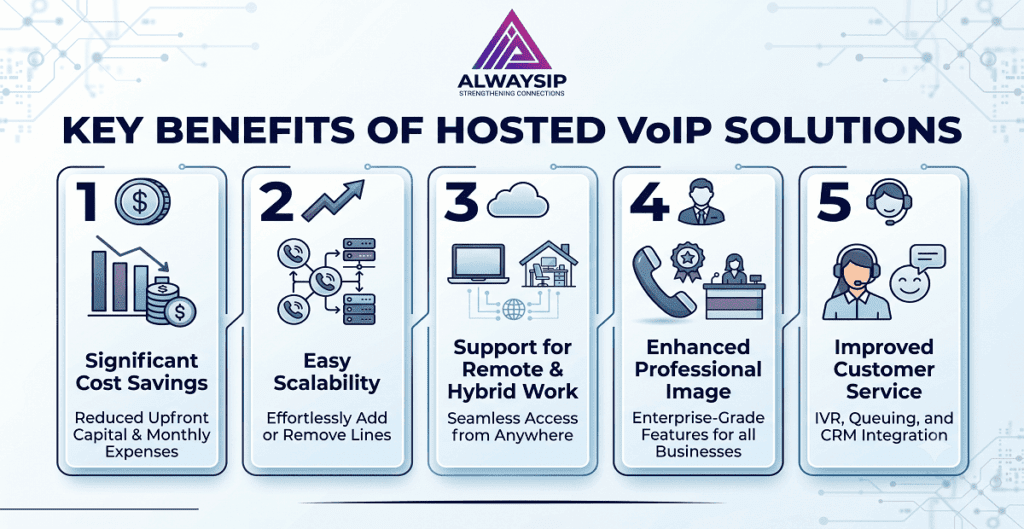
1. Significant Cost Savings
One of the biggest reasons small businesses switch to Hosted VoIP Solutions is cost reduction.
Traditional phone systems typically require:
- Expensive PBX hardware
- Installation fees
- Ongoing maintenance costs
- Separate phone line charges
Hosted VoIP Solutions eliminate many of these expenses by using existing internet connections and cloud-based infrastructure.
Businesses can also benefit from:
- Lower call rates
- Reduced international calling costs
- Predictable monthly pricing
- Minimal maintenance expenses
This allows organizations to allocate more resources toward growth and innovation.
2. Easy Scalability
As businesses grow, communication requirements change.
Hosted VoIP Solutions make it easy to:
- Add new users
- Create additional extensions
- Open new locations
- Support remote employees
Instead of purchasing new equipment, administrators can simply update settings through an online portal.
This flexibility makes Hosted VoIP Solutions ideal for growing businesses.
3. Support for Remote and Hybrid Work
Modern work environments have evolved significantly. Employees often work from home, travel frequently, or operate across multiple locations.
Hosted VoIP Solutions allow team members to stay connected using:
- Mobile apps
- Desktop applications
- Softphones
- IP desk phones
Employees can make and receive business calls from anywhere while maintaining a professional business identity.
This ensures continuity and productivity regardless of location.
4. Enhanced Professional Image
Small businesses can appear larger and more professional by using advanced communication features typically associated with large enterprises.
Hosted VoIP Solutions often include:
- Auto attendants
- Custom greetings
- Call routing
- Voicemail-to-email
- Business phone numbers
These features create a seamless customer experience and help build trust with clients.
5. Improved Customer Service
Customer satisfaction depends heavily on communication quality.
Hosted VoIP Solutions provide tools that help businesses respond faster and more efficiently.
Examples include:
- Intelligent call routing
- Call queues
- Call forwarding
- Presence indicators
- CRM integrations
By ensuring customers reach the right person quickly, businesses can improve service quality and customer retention.
Essential Features of Hosted VoIP Solutions
Auto Attendant
An auto attendant acts as a virtual receptionist.
It greets callers and directs them to the appropriate department without requiring manual intervention.
This feature improves efficiency and provides a professional customer experience.
Call Forwarding
Call forwarding ensures important calls never go unanswered.
Businesses can redirect calls to:
- Mobile phones
- Remote employees
- Alternate departments
- Backup numbers
This feature is especially valuable for remote and hybrid teams.
Voicemail-to-Email
Voicemail-to-email automatically converts voicemail messages into audio files and sends them directly to email inboxes.
Benefits include:
- Faster response times
- Improved accessibility
- Better message management
Employees can listen to messages from any device.
Call Recording
Call recording allows businesses to monitor and review conversations.
This feature supports:
- Employee training
- Quality assurance
- Compliance requirements
- Dispute resolution
Many small businesses use recorded calls to improve customer interactions.
Video Conferencing
Many Hosted VoIP Solutions include integrated video conferencing tools.
This enables teams to:
- Conduct virtual meetings
- Collaborate remotely
- Reduce travel costs
- Improve communication efficiency
A unified communication platform simplifies daily operations.
Analytics and Reporting
Detailed call analytics help businesses understand communication performance.
Reports often include:
- Call volumes
- Average wait times
- Missed calls
- Agent performance
- Customer service metrics
These insights support better decision-making and operational improvements.
Security in Hosted VoIP Solutions
Security is a common concern for businesses considering cloud-based communications.
Modern Hosted VoIP Solutions include robust security measures such as:
- Data encryption
- Secure data centers
- Multi-factor authentication
- Network monitoring
- Fraud detection systems
When implemented correctly, Hosted VoIP Solutions can provide a highly secure communication environment.
Businesses should also ensure they work with reputable providers that prioritize security and compliance.
Hosted VoIP Solutions vs Traditional Phone Systems
Traditional Phone Systems
Advantages:
- Familiar technology
- Independent of internet connectivity
Limitations:
- Higher costs
- Limited scalability
- Expensive maintenance
- Reduced flexibility
Hosted VoIP Solutions
Advantages:
- Lower operating costs
- Advanced features
- Easy scalability
- Remote accessibility
- Cloud-based management
Limitations:
- Requires reliable internet connectivity
For most small businesses, Hosted VoIP Solutions offer greater value, flexibility, and long-term savings.
How to Choose the Right Hosted VoIP Solutions Provider
Selecting the right provider is crucial for success.
Consider the following factors:
Reliability
Look for providers with strong uptime guarantees and redundant infrastructure.
Features
Ensure the solution includes essential communication tools that match your business needs.
Scalability
Choose a platform that can grow alongside your business.
Security
Verify that the provider offers advanced security measures and compliance support.
Customer Support
Reliable technical support can minimize downtime and resolve issues quickly.
Pricing Transparency
Understand all costs before committing to a service agreement.
A reputable provider should offer flexible plans without hidden fees.
Common Challenges and How to Avoid Them
Poor Internet Connection
A stable internet connection is essential for call quality.
Businesses should invest in reliable broadband or dedicated connectivity solutions.
Lack of Employee Training
Staff should understand how to use communication tools effectively.
Proper onboarding improves adoption and productivity.
Choosing the Wrong Provider
Research providers carefully and evaluate reviews, service levels, and feature availability before making a decision.
The Future of Hosted VoIP Solutions
Business communication continues to evolve rapidly.
Future developments in Hosted VoIP Solutions are expected to include:
- AI-powered call management
- Advanced analytics
- Improved automation
- Enhanced integrations
- Smarter customer service tools
As technology advances, Hosted VoIP Solutions will continue to play a critical role in helping businesses stay connected and competitive.
Conclusion
For small businesses looking to modernize communication, reduce costs, and support flexible work environments, Hosted VoIP Solutions offer a powerful alternative to traditional phone systems.
With features such as call forwarding, auto attendants, video conferencing, analytics, and remote accessibility, Hosted VoIP Solutions deliver enterprise-level capabilities without the complexity and expense of legacy systems.
As businesses continue to embrace digital transformation, investing in Hosted VoIP Solutions can improve efficiency, enhance customer service, and create a scalable communication foundation for future growth.
Frequently Asked Questions (FAQs)
What are Hosted VoIP Solutions?
Hosted VoIP Solutions are cloud-based phone systems that allow businesses to make and receive calls over the internet rather than traditional telephone lines.
Are Hosted VoIP Solutions suitable for small businesses?
Yes. Hosted VoIP Solutions are particularly beneficial for small businesses because they offer lower costs, advanced features, and easy scalability.
Do Hosted VoIP Solutions require special hardware?
Not necessarily. Businesses can use IP phones, computers, smartphones, or softphone applications to access Hosted VoIP Solutions.
Are Hosted VoIP Solutions secure?
Modern Hosted VoIP Solutions include encryption, authentication, and secure infrastructure to protect communications and business data.
Can employees use Hosted VoIP Solutions while working remotely?
Yes. Employees can access Hosted VoIP Solutions from virtually anywhere using internet-connected devices.
How much can businesses save with Hosted VoIP Solutions?
Savings vary by organization, but many businesses significantly reduce hardware, maintenance, and calling costs after switching to Hosted VoIP Solutions.
What internet speed is required for Hosted VoIP Solutions?
Most providers recommend a stable, high-speed internet connection with sufficient bandwidth to support voice traffic and maintain call quality.