
Customer expectations have changed significantly. People want quick answers, convenient communication options and helpful service without having to repeat their information every time they contact a business.
For businesses, meeting those expectations can be difficult when customer communications are managed through outdated phone systems, disconnected applications or office-based infrastructure.
This is where cloud contact centre technology can make a difference.
A cloud contact centre moves the core technology needed to manage customer interactions into a cloud-based environment. Instead of relying heavily on physical contact centre hardware, businesses can use internet-connected systems to manage calls, digital channels, customer information, reporting and agent workflows.
The benefits of cloud contact center solutions go beyond simply moving a phone system to the cloud. Modern platforms can bring together communication channels, customer data, automation, analytics and flexible working into a more connected environment.
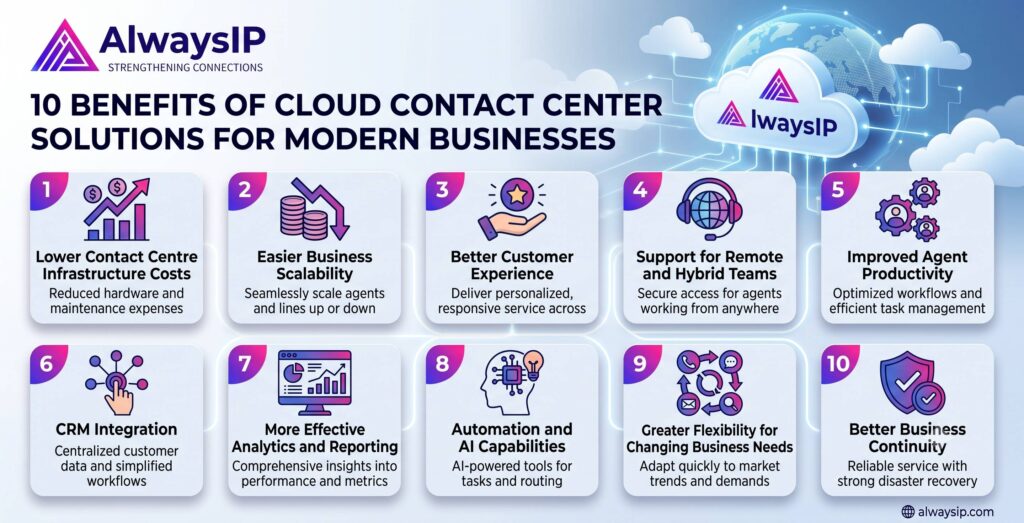
Here are ten important benefits businesses should consider.
1. Lower Contact Centre Infrastructure Costs
One of the most noticeable benefits of cloud contact center solutions is the potential to reduce the need for traditional infrastructure.
A conventional contact centre may require dedicated telephony hardware, servers, physical workstations and ongoing maintenance. As the business grows, expanding this infrastructure can involve additional investment and IT resources.
With a cloud-based approach, much of the underlying technology is hosted and managed within the cloud platform. This can reduce the amount of hardware a business needs to purchase and maintain internally.
Cloud services can also offer flexible pricing models, depending on the provider. Some platforms use usage-based pricing, while others use subscription or user-based models.
The right approach depends on the business’s contact volumes, number of agents and required features.
2. Easier Business Scalability
Customer contact volumes do not always remain consistent.
A business may experience busy periods during seasonal campaigns, product launches, holidays or unexpected increases in demand. A traditional contact centre can struggle when capacity is fixed around a specific number of users or physical workstations.
Cloud technology makes scaling much more flexible.
Businesses can generally add users, adjust configurations and expand capacity without installing large amounts of new physical infrastructure. Cloud contact centre platforms are designed to scale with changing demand.
This means a growing company does not necessarily have to redesign its entire contact centre every time the customer service team expands.
3. Better Customer Experience
Customers judge businesses not only by the products they purchase but also by how easy it is to get support.
Long waiting times, repeated explanations and disconnected communication channels can create frustration.
Cloud contact centre solutions can bring different communication methods into a more connected customer service environment. Depending on the platform, these may include voice, email, chat, SMS and other digital channels.
For example, a customer might begin a conversation through digital messaging and later speak with an agent. When customer information and interaction history are available to the agent, the conversation can be more informed.
The result is a smoother journey for both customers and employees.
4. Support for Remote and Hybrid Teams
Modern businesses are no longer restricted to one office.
Customer service teams may include employees working from home, different offices or multiple locations.
Cloud contact centre technology can make this type of working easier because agents can access the required tools through an internet connection rather than being tied to a specific physical contact centre environment.
This can give businesses greater flexibility when organising teams and responding to changing working patterns. Cloud contact centre platforms can support agents working remotely while maintaining access to contact centre functions.
For businesses with distributed teams, this flexibility can be particularly valuable.
5. Improved Agent Productivity
Customer service agents often spend too much time switching between applications, searching for information and manually recording interaction details.
A modern cloud contact centre can bring more of these functions together.
Features such as intelligent routing, unified agent interfaces, call information, customer records, call history and automated workflows can help reduce unnecessary manual tasks.
Some modern platforms also provide AI-powered tools such as conversation summaries, real-time transcription, sentiment analysis and automated assistance.
This allows agents to spend more time focusing on the customer rather than managing multiple disconnected systems.
6. CRM Integration
Customer relationship management systems contain valuable information about customers, including contact details, previous interactions, sales activity and support history.
When the contact centre and CRM operate separately, agents may need to search for information manually.
CRM integration can help connect customer communication with customer records.
For example, when an interaction arrives, an integrated system may allow the agent to access relevant customer information from the same working environment.
This can make conversations more personalised and reduce the need for customers to repeat information they have already provided.
CRM integration is therefore one of the important benefits of cloud contact center solutions for businesses looking to create a more connected customer service operation. Cloud contact centre platforms can integrate with CRM systems to provide agents with customer information and interaction history.
7. More Effective Analytics and Reporting
You cannot improve what you cannot measure.
Contact centres generate a large amount of information about customer interactions and agent performance.
Cloud platforms can provide reporting and analytics covering areas such as:
- Call volumes
- Waiting times
- Agent activity
- Queue performance
- Customer interactions
- Call handling
- Service trends
- Contact channel usage
Real-time dashboards can help managers understand what is happening across the contact centre, while historical reports can highlight longer-term patterns.
This information can support better operational decisions.
For example, if call volumes regularly increase during a particular period, management can use previous data to plan staffing more effectively.
Modern contact centre platforms can also use analytics and AI to provide deeper insight into conversations and performance.
8. Automation and AI Capabilities
Automation is becoming an increasingly important part of customer communication.
Not every customer enquiry requires a human agent. Simple questions, routine requests and basic information can sometimes be handled through automated systems.
Cloud contact centres can support features such as:
- Interactive voice response
- Chatbots
- Virtual assistants
- Automated call routing
- AI-powered summaries
- Conversation transcription
- Sentiment analysis
- Intelligent customer routing
AI-powered virtual agents can also help businesses handle certain processes without requiring an agent for every step. AWS, for example, describes cloud contact centre use cases where AI automation can help with customer interactions, scalability and agent productivity.
The goal should not necessarily be to remove human interaction. Instead, automation can handle suitable routine tasks while allowing employees to focus on conversations that require human judgement, empathy or problem-solving.
9. Greater Flexibility for Changing Business Needs
Business requirements can change quickly.
A company might open a new location, launch a new service, introduce a temporary support team or experience a sudden increase in customer enquiries.
Cloud contact centre solutions provide a more flexible foundation for responding to these changes.
Instead of planning every expansion around physical infrastructure, businesses can make changes within the cloud environment.
This flexibility can be particularly useful for growing companies that do not want their communication technology to become a limitation.
Cloud platforms can also support rapid changes to contact flows, routing and capacity, helping organisations respond to fluctuations in demand.
10. Better Business Continuity
Customer service cannot simply stop when something goes wrong at the main office.
Power problems, equipment failures, office closures or other unexpected events can disrupt traditional contact centre operations.
A cloud-based contact centre can provide greater flexibility because agents do not necessarily need to work from the same physical location.
If the necessary internet connectivity and devices are available, teams may be able to continue handling customer interactions from alternative locations.
This can help businesses create a more resilient customer service strategy.
Business continuity still depends on the provider’s architecture, connectivity, security controls and implementation, so businesses should assess these areas carefully before choosing a solution.
What Makes Cloud Contact Centres Different?
The biggest difference is flexibility.
Traditional contact centre infrastructure is often closely connected to a physical location. Cloud technology changes that model by making contact centre functionality available through cloud-based services.
This can bring together communication, customer information, routing, reporting and automation in a more connected environment.
However, not every cloud contact centre is the same.
Businesses should look at the features they actually need rather than choosing a platform simply because it is cloud-based.
Important areas to consider include:
- Voice and digital communication channels
- CRM integrations
- Call routing
- IVR
- Call recording
- Real-time monitoring
- Analytics
- AI capabilities
- Remote agent support
- Security
- Reliability
- Scalability
- Provider support
How to Choose the Right Cloud Contact Center Solution
Before investing in a platform, businesses should start by understanding their existing communication challenges.
Ask questions such as:
How many customer interactions do we handle each month?
Understanding current volumes provides a useful starting point for selecting the right capacity and pricing model.
Which communication channels do our customers prefer?
If customers regularly use voice, email, chat or messaging, the chosen solution should support the channels that matter to the business.
Do we need CRM integration?
If agents rely heavily on customer records, CRM integration could be an important requirement.
Will our team work remotely?
If remote or hybrid working is part of the business model, check how easily agents can access the contact centre from different locations.
Which AI and automation features are genuinely useful?
AI can offer valuable capabilities, but businesses should focus on practical use cases rather than choosing technology simply because it includes AI.
How does the provider handle security and reliability?
Customer communications can contain sensitive information, so security, access controls, data handling and resilience should be carefully evaluated.
Final Thoughts
The benefits of cloud contact center solutions extend across customer experience, employee productivity, scalability, analytics, automation and operational flexibility.
For modern businesses, the contact centre is no longer simply a place where employees answer phone calls. It is becoming a connected customer communication environment where voice, digital channels, CRM information, analytics and AI can work together.
Cloud technology can provide the foundation for this approach while giving businesses greater flexibility as their requirements change.
The most important step is choosing a solution based on actual business needs. A well-planned cloud contact centre should make it easier for employees to serve customers, easier for managers to understand performance and easier for the business to adapt as it grows.
Frequently Asked Questions
What are the main benefits of cloud contact center solutions?
The main benefits include greater scalability, flexible working, improved customer experiences, lower infrastructure requirements, CRM integration, better analytics, automation and increased operational flexibility.
Are cloud contact center solutions suitable for small businesses?
Yes. Cloud platforms can be suitable for small and growing businesses because they can provide access to contact centre capabilities without requiring the same level of physical infrastructure associated with traditional systems. The right solution will depend on the company’s size, customer volume and requirements.
Can cloud contact centres support remote employees?
Yes. Many cloud contact centre platforms are designed to support distributed and remote teams. Agents can often access their contact centre tools through an internet-connected device, subject to the provider’s requirements.
Can a cloud contact centre integrate with CRM software?
Yes. CRM integration is a common capability in modern cloud contact centre platforms. It can allow agents to access customer information and interaction history while handling communications.
Do cloud contact centres use AI?
Many modern platforms offer AI features, although capabilities differ between providers. These can include virtual agents, automated interactions, conversation summaries, transcription, sentiment analysis and intelligent routing.
Can cloud contact centre solutions reduce business costs?
They can potentially reduce infrastructure and operational costs by reducing the need for on-site contact centre hardware and allowing businesses to scale resources according to demand. Actual savings depend on the provider, pricing model, usage and implementation.
Are cloud contact centre solutions secure?
Cloud platforms can include security controls such as access management, encryption, monitoring and other protections, but security varies between providers. Businesses should assess the provider’s security architecture, data handling practices and compliance requirements before making a decision.
Why are businesses moving from traditional contact centres to the cloud?
Businesses are increasingly looking for flexible communication systems that can support remote teams, digital channels, automation, analytics and changing customer demand. Cloud technology can provide these capabilities without relying entirely on traditional physical infrastructure.
How can a business get started with a cloud contact centre?
Start by reviewing your current contact volumes, communication channels, CRM requirements, agent workflows and business goals. Then compare providers based on functionality, scalability, integrations, security, support and overall cost.