
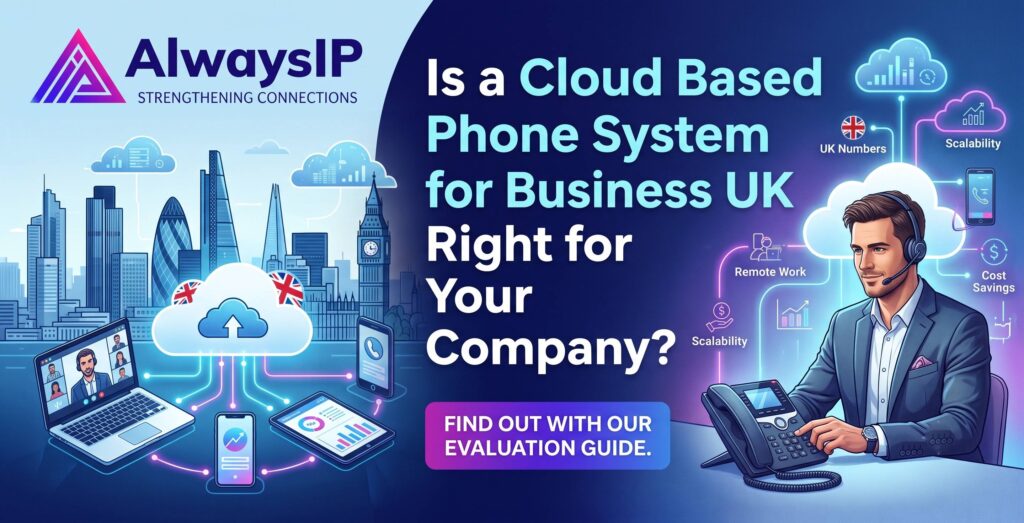
Business communication has changed significantly in recent years. Employees are no longer always sitting at the same desk, customers expect faster responses, and businesses increasingly rely on digital tools to keep teams connected.
For many UK companies, traditional phone systems are no longer the best fit for the way people work. A Cloud Based Phone System for Business UK can provide a more flexible approach, allowing employees to make and receive business calls through internet-connected devices while giving businesses access to a wider range of communication features.
But is moving to a cloud phone system the right decision for every company?
The answer depends on how your business operates, how your employees communicate and what you expect from your phone system in the future. In this guide, we explore how cloud phone systems work, their main benefits, potential challenges and the signs that your company may be ready to make the move.
What Is a Cloud Based Phone System?
A cloud phone system is a business telephone solution that operates using an internet connection rather than relying entirely on traditional telephone infrastructure.
Instead of keeping a physical telephone system and much of the associated hardware on your premises, the core phone system is hosted in the cloud by a service provider.
Calls can be handled through compatible desk phones, computers, smartphones, tablets or web-based applications. This means employees can often access their business communication tools from the office, home or another suitable location.
Cloud phone systems are commonly built around VoIP technology, which converts voice communication into digital data that can travel over an internet connection.
Ofcom has described the UK’s transition from traditional PSTN services towards VoIP and other digital technologies as part of the wider move to modernise fixed telephone services.
Why Are UK Businesses Moving Towards Cloud Phone Systems?
The traditional office phone system was designed around a very different working environment.
Employees generally had a fixed desk, a fixed telephone and a single office location. Modern businesses are more dynamic. Teams may work from multiple offices, remotely or in hybrid environments.
Customers also communicate differently. Businesses now need more than basic incoming and outgoing calls. They may need call routing, voicemail-to-email, mobile access, call recording, analytics, CRM integration and automated call handling.
A Cloud Based Phone System for Business UK can bring many of these functions together in one platform.
There is also another important consideration for UK businesses: the retirement of legacy PSTN infrastructure. Ofcom’s January 2026 communication states that BT plans to retire its PSTN by 31 January 2027, making preparation for digital alternatives increasingly important.
What Are the Main Benefits of a Cloud Based Phone System for Business UK?
1. Greater Flexibility for Employees
One of the biggest advantages of cloud communication is flexibility.
Employees do not necessarily have to be tied to one physical desk to handle business calls. Depending on the system, they may be able to use a desktop application, mobile app, browser or compatible business handset.
This can be particularly useful for businesses with:
- Remote employees
- Hybrid teams
- Multiple offices
- Mobile workers
- Sales teams
- Customer service teams
- Employees who frequently travel
Instead of having separate communication arrangements for office and remote workers, businesses can provide a more consistent calling experience across locations.
2. Support for Remote and Hybrid Working
Hybrid working has changed expectations around business communication.
A customer calling a company’s main number should be able to reach the appropriate team even when employees are working outside the office.
With a suitable cloud phone system, calls can potentially be routed to different users, departments or devices according to business requirements.
Employees can also maintain a professional business presence without giving customers their personal mobile numbers.
For growing businesses, this can make communication easier to manage as teams become more distributed.
3. Access to Advanced Calling Features
A traditional phone system may provide the basic ability to make and receive calls, but modern cloud systems can offer considerably more.
Depending on the provider and package, features can include:
- Auto attendants
- Call routing
- Call queues
- Call recording
- Voicemail-to-email
- Call forwarding
- Call transfer
- Call monitoring
- Call analytics
- Mobile applications
- CRM integration
- Business SMS
- AI-powered call transcription
- Video calling
- Real-time reporting
The important point is that businesses should not choose a system simply because it has a long list of features.
The better question is: Which features will actually improve the way your company communicates?
4. Easier Business Growth
Traditional phone systems can become difficult to manage when a company grows.
Adding employees may require additional hardware, extensions or configuration. Opening another location can introduce another layer of complexity.
A cloud-based approach can make scaling more straightforward because users and extensions can often be managed through an online platform.
For example, a company that grows from 10 employees to 30 may need additional users, numbers and call-routing options. A cloud platform can provide a more flexible foundation for this expansion.
5. Potentially Lower Infrastructure Costs
Cost is another reason businesses consider cloud communication.
With an on-premise phone system, businesses may need to invest in hardware, maintenance and upgrades. Cloud systems typically shift more of the infrastructure management to the provider.
However, businesses should avoid assuming that every cloud system will automatically be cheaper.
The real cost depends on factors such as:
- Number of users
- Calling requirements
- Hardware
- Internet connectivity
- Features
- Contract terms
- Support
- Setup and migration
- Existing telephone numbers
A proper comparison should consider the total cost of ownership, rather than simply comparing monthly subscription prices.
Ofcom notes that cost is one of the reasons businesses consider switching communications providers, but also advises businesses to consider their actual requirements when choosing services.
Is a Cloud Phone System Suitable for Small Businesses?
Yes. In fact, small businesses can benefit significantly from cloud communication.
A small company may not have an internal IT department to maintain a complex telephone system. A hosted cloud solution can reduce the amount of phone-system infrastructure that needs to be managed directly by the business.
It can also give smaller companies access to professional features that might previously have been associated with larger organisations.
For example, a small team could have a main business number, automated greetings, call routing, voicemail and mobile access without building a large telephone infrastructure.
The key is choosing a solution that matches the company’s current needs without paying for unnecessary functionality.
What About Larger Businesses?
Larger organisations can also benefit from a Cloud Based Phone System for Business UK, particularly when they have multiple departments or locations.
Cloud systems can help centralise communication management across different offices.
A company could potentially manage:
- Multiple business numbers
- Departments
- Extensions
- Call queues
- User permissions
- Call routing
- Reporting
- Office locations
from a central platform.
This can make administration easier and provide management teams with greater visibility into business communications.
How Secure Is a Cloud Phone System?
Security should be an important consideration when selecting any business communication platform.
Cloud phone systems handle business calls and potentially sensitive customer information, so companies should investigate how a provider protects its infrastructure and customer data.
Businesses should ask providers about:
- Account security
- User authentication
- Encryption
- Data protection
- Access controls
- Backup procedures
- Network security
- Fraud prevention
- Monitoring
- Business continuity
Security is not simply the responsibility of the provider, either. Businesses should also use strong passwords, control user permissions and train employees to recognise suspicious activity.
Does Your Business Have a Reliable Internet Connection?
This is one of the most important questions to ask before moving to cloud calling.
Because cloud phone systems rely on internet connectivity, businesses need a connection capable of supporting their expected voice traffic and other online applications.
If your company already depends heavily on cloud applications, video conferencing and online systems, your internet connection may already be suitable. However, it is still worth assessing bandwidth, reliability and resilience before migration.
For businesses where phone communication is critical, a suitable business broadband or leased line connection may be worth considering.
What About the UK’s PSTN Switch Off?
The UK’s transition away from traditional PSTN infrastructure is another reason businesses should review their existing telephone arrangements.
Ofcom says the PSTN is being retired as the UK’s communications infrastructure moves towards digital alternatives. Its latest reporting identifies January 2027 as the retirement date for the PSTN.
This does not mean every business must choose exactly the same replacement solution. However, companies still depending on legacy telephone services should understand how their current setup will be affected.
Businesses should also identify equipment connected to telephone lines, because some devices may require additional consideration during migration.
How Do You Know If Your Company Is Ready?
Your company may be a strong candidate for a Cloud Based Phone System for Business UK if you experience one or more of these challenges:
- Your phone system is difficult to manage
- Employees regularly work remotely
- You have multiple offices
- You want better call management
- Your current system is expensive to maintain
- You need better call reporting
- You want CRM integration
- You are expanding your team
- You want employees to use business calling on mobile devices
- You are still relying on legacy telephone infrastructure
If several of these apply, it may be time to review your current communication setup.
What Should You Look for in a Cloud Phone Provider?
Choosing the right provider is just as important as choosing the technology.
Look for a provider that understands your business requirements rather than simply selling a standard package.
Consider:
Reliability
Business calls are critical. Ask about network resilience, uptime and support arrangements.
Features
Make sure the system provides the features your teams actually need.
Scalability
Check how easily you can add users, numbers, locations and functionality as the company grows.
Support
Find out when support is available and how technical issues are handled.
Number Porting
If you already have established business numbers, ask how the provider will manage number porting and migration.
Integration
If your employees use CRM, Microsoft Teams or other business applications, check whether the phone platform can integrate with your existing technology.
Is a Cloud Based Phone System Right for Your Company?
For many UK businesses, the answer is yes.
A Cloud Based Phone System for Business UK can provide greater flexibility, support hybrid working, introduce advanced calling features and create a more scalable communication environment.
However, there is no single solution that is right for every company.
The best approach is to assess your existing phone system, internet connection, workforce, communication requirements and future plans before making a decision.
If your current system is becoming difficult to manage or your business is preparing for the continued move away from legacy telephone infrastructure, now is a sensible time to explore your options.
The goal should not simply be to replace an old phone system. It should be to create a communication platform that helps your employees work more effectively and gives your customers a better experience.
Frequently Asked Questions
What is a Cloud Based Phone System for Business UK?
A Cloud Based Phone System for Business UK is a business telephone solution hosted through the internet rather than relying primarily on traditional on-premise telephone infrastructure. It can provide calling, call routing, voicemail, mobile access and other business communication features.
Is a cloud phone system suitable for small businesses?
Yes. Cloud phone systems can be suitable for small businesses because they can provide professional calling features without requiring a large on-site telephone infrastructure.
Can employees use a cloud phone system from home?
Yes, depending on the provider and solution. Many cloud systems support desktop applications, mobile apps and browser-based calling, allowing employees to handle business communications remotely.
Is a cloud phone system cheaper than a traditional phone system?
It can be, but this depends on the solution and business requirements. Businesses should compare the total cost of hardware, maintenance, licences, calling, support and connectivity rather than looking only at monthly subscription prices.
Will I lose my existing business telephone number?
Not necessarily. Many providers support business number porting, allowing established numbers to be transferred to the new service. You should confirm the process and timescales with your chosen provider.
Does a cloud phone system require broadband?
Yes. Cloud phone systems generally depend on internet connectivity because calls are delivered using IP technology. A reliable business internet connection is therefore important.
Is a cloud phone system secure?
A well-designed cloud phone system can include security controls such as authentication, access management, monitoring and fraud protection. Businesses should assess the provider’s security measures before choosing a service.
Is now a good time for UK businesses to move to cloud calling?
For businesses still using legacy telephone infrastructure, it is worth reviewing their options now. The UK’s transition away from PSTN is progressing, with January 2027 identified by Ofcom as the PSTN retirement date.
Final Thoughts
The way businesses communicate is changing. Employees need flexibility, customers expect professional service and companies need technology that can adapt as they grow.
A Cloud Based Phone System for Business UK can bring calling, mobility, collaboration and advanced communication features into one flexible environment.
The right solution will depend on your company’s size, workforce, connectivity, budget and communication goals. Rather than choosing a system based purely on price or the number of features advertised, focus on what your business actually needs today and where you expect it to be in the future.
For UK businesses reviewing their telephone infrastructure, cloud communication is no longer simply an alternative to traditional phone systems. It is becoming an important part of the transition towards modern business communications.