
In today’s competitive business environment, attracting customer attention and delivering information effectively has become more challenging than ever. Traditional printed posters, banners, and static signs often fail to capture attention or adapt quickly to changing business needs. This is where a Digital Signage Screen is transforming the way organizations communicate with customers, employees, and visitors.
From retail stores and restaurants to hotels, healthcare facilities, educational institutions, and corporate offices, businesses are increasingly investing in digital display technology. A Digital Signage Screen offers dynamic content, real-time updates, and engaging visuals that help organizations improve communication, strengthen branding, and increase sales.
This article explores the major benefits of using a Digital Signage Screen and explains why more businesses are making the switch from traditional signage to digital solutions.
What Is a Digital Signage Screen?
A Digital Signage Screen is a digital display used to present multimedia content such as videos, images, announcements, promotions, menus, schedules, and advertisements. These screens can be installed indoors or outdoors and are managed through software that allows businesses to update content remotely.
Unlike traditional signage, digital displays provide flexibility and allow organizations to deliver relevant information instantly. Whether promoting products, sharing company updates, or guiding visitors, a Digital Signage Screen serves as a powerful communication tool.
Why Businesses Are Moving Away from Traditional Signage
Traditional signs have served businesses for decades, but they come with limitations:
- High printing and replacement costs
- Limited content flexibility
- Time-consuming updates
- Inability to display dynamic content
- Reduced customer engagement
Modern businesses require communication methods that are fast, adaptable, and visually appealing. A Digital Signage Screen addresses these challenges while offering long-term value.
1. Enhanced Customer Engagement
One of the biggest advantages of a Digital Signage Screen is its ability to capture attention.
Bright visuals, animations, videos, and interactive content naturally attract more viewers than static printed signs. Customers are more likely to notice and engage with dynamic displays, especially in busy environments such as shopping centers, airports, and retail stores.
Businesses can use digital signage to:
- Promote new products
- Highlight special offers
- Display customer testimonials
- Showcase brand videos
- Share educational content
When customers engage with content, they spend more time interacting with a brand, which often leads to increased purchasing decisions.
2. Real-Time Content Updates
Traditional signage requires printing, shipping, and manual installation whenever information changes. This process can be costly and time-consuming.
A Digital Signage Screen allows businesses to update content instantly through cloud-based management systems. Changes can be made within minutes and displayed across multiple locations simultaneously.
This capability is especially valuable for:
- Retail promotions
- Restaurant menu updates
- Corporate announcements
- Event schedules
- Emergency notifications
Real-time content management ensures that audiences always receive accurate and current information.
3. Improved Brand Visibility
Building a strong brand identity requires consistent and professional communication. A Digital Signage Screen helps businesses reinforce their brand image through high-quality visuals and customized messaging.
Organizations can display:
- Brand colors and logos
- Promotional videos
- Corporate messages
- Product showcases
- Customer success stories
Consistent branding across digital displays creates a memorable experience and strengthens brand recognition among customers and visitors.
4. Increased Sales and Revenue
Many businesses invest in digital signage because of its direct impact on sales.
A strategically placed Digital Signage Screen can influence customer purchasing decisions by displaying targeted promotions and product recommendations at the right time.
Examples include:
- Upselling products at checkout counters
- Promoting limited-time discounts
- Highlighting best-selling items
- Advertising complementary products
By delivering compelling visual content, businesses can encourage impulse purchases and improve overall revenue.
5. Cost Savings Over Time
While the initial investment in a Digital Signage Screen may be higher than traditional signage, the long-term savings can be substantial.
Businesses save money by eliminating:
- Printing expenses
- Graphic redesign costs
- Shipping charges
- Installation costs for new signs
- Waste associated with discarded materials
Over time, digital signage becomes a cost-effective communication solution that reduces operational expenses while improving efficiency.
6. Better Internal Communication
Digital signage is not limited to customer-facing applications. Many organizations use a Digital Signage Screen to improve communication with employees.
Screens placed in offices, warehouses, and break rooms can display:
- Company news
- Performance metrics
- Safety reminders
- Training content
- Employee recognition messages
Providing important information through visual displays helps keep teams informed and engaged.
7. Supports Multi-Location Businesses
Managing communication across multiple locations can be challenging. A centralized Digital Signage Screen solution simplifies this process by allowing businesses to control content remotely.
Companies with multiple branches can:
- Deliver consistent branding
- Launch nationwide campaigns
- Schedule location-specific content
- Monitor display performance
This level of control ensures messaging remains accurate and aligned with business objectives.
8. Creates a Modern Customer Experience
Today’s consumers expect modern and technology-driven experiences. Businesses that adopt digital solutions often appear more innovative and customer-focused.
A Digital Signage Screen enhances the customer journey by providing:
- Interactive experiences
- Digital directories
- Self-service information
- Wayfinding assistance
- Real-time updates
These features contribute to a more professional and engaging environment.
9. Greater Flexibility for Marketing Campaigns
Marketing campaigns often require frequent adjustments based on customer behavior, seasonal trends, or market conditions.
With a Digital Signage Screen, businesses can quickly:
- Change promotional messages
- Test different advertisements
- Schedule campaigns by time and date
- Target specific audiences
This flexibility allows marketers to respond rapidly to opportunities and maximize campaign effectiveness.
10. Environmentally Friendly Communication
Many organizations are seeking sustainable solutions that reduce environmental impact.
A Digital Signage Screen helps reduce:
- Paper consumption
- Printing waste
- Transportation emissions
- Disposable marketing materials
By replacing printed signs with digital displays, businesses can support sustainability initiatives while maintaining effective communication.
11. Valuable Analytics and Insights
Advanced digital signage platforms often include analytics features that help businesses measure content performance.
Organizations can track:
- Viewer engagement
- Campaign effectiveness
- Content schedules
- Audience behavior patterns
These insights enable businesses to make data-driven decisions and optimize future marketing efforts.
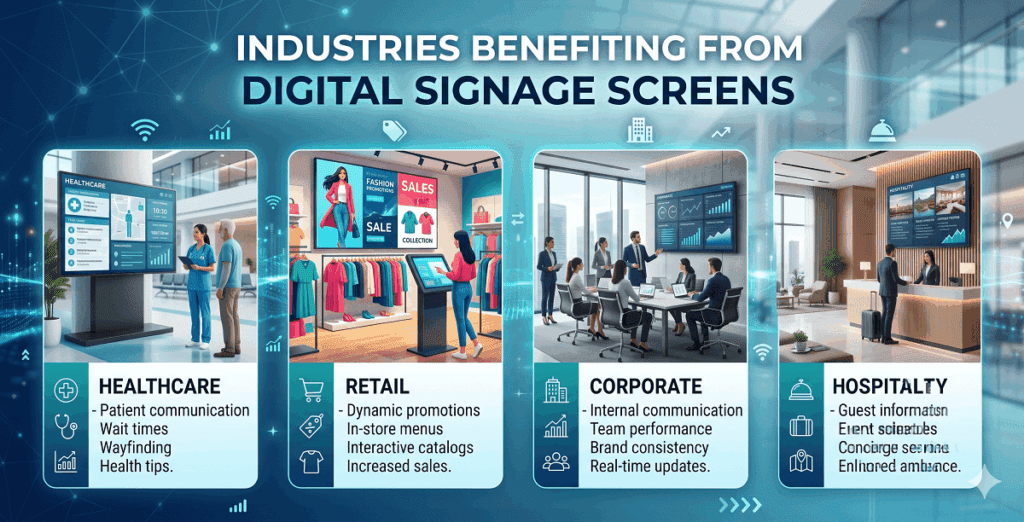
Industries Benefiting from Digital Signage Screens
Retail
Retail stores use Digital Signage Screen solutions to promote products, display offers, and improve customer engagement.
Hospitality
Hotels utilize digital displays for guest information, event schedules, wayfinding, and promotional content.
Healthcare
Hospitals and clinics use digital signage to provide patient information, queue management, and health awareness campaigns.
Education
Schools, colleges, and universities display announcements, schedules, emergency notifications, and event information.
Corporate Offices
Businesses use Digital Signage Screen technology to communicate company updates, performance metrics, and internal news.
How to Choose the Right Digital Signage Screen
Before investing in a Digital Signage Screen, businesses should consider:
Display Size
Choose a screen size based on viewing distance and installation location.
Indoor or Outdoor Use
Outdoor screens require weatherproof and high-brightness capabilities.
Resolution
High-resolution displays deliver sharper images and a better viewing experience.
Content Management System
Select software that supports easy content scheduling and remote management.
Connectivity Options
Ensure compatibility with your existing network and digital infrastructure.
The Future of Digital Signage Screens
As technology continues to evolve, Digital Signage Screen solutions are becoming more intelligent and interactive. Innovations such as artificial intelligence, touchscreen functionality, cloud management, and audience analytics are creating even more opportunities for businesses.
Future digital signage systems will deliver personalized content, improve customer experiences, and provide deeper insights into audience behavior.
Organizations that adopt digital signage today are positioning themselves for long-term success in an increasingly digital world.
Conclusion
The growing popularity of the Digital Signage Screen is driven by its ability to improve communication, enhance customer engagement, strengthen branding, and increase operational efficiency. Businesses across various industries are discovering that digital displays offer far greater flexibility and effectiveness than traditional signage.
Whether used for marketing, customer service, employee communication, or information sharing, a Digital Signage Screen provides a modern and scalable solution that delivers measurable results. As businesses continue to embrace digital transformation, investing in digital signage is becoming a strategic decision rather than a luxury.
Frequently Asked Questions
What is a Digital Signage Screen used for?
A Digital Signage Screen is used to display advertisements, announcements, promotions, menus, schedules, and other visual content in business environments.
How does a Digital Signage Screen improve customer engagement?
Digital displays use dynamic content, videos, and animations that attract attention and encourage customers to interact with information.
Is a Digital Signage Screen suitable for small businesses?
Yes. Small businesses can use digital signage to promote products, communicate with customers, and improve brand visibility without recurring printing costs.
Can a Digital Signage Screen be managed remotely?
Yes. Most modern digital signage systems include cloud-based software that allows remote content management and scheduling.
Are Digital Signage Screens cost-effective?
Although the initial investment may be higher, Digital Signage Screen solutions reduce printing and maintenance costs, making them cost-effective over time.
Which industries benefit most from Digital Signage Screen technology?
Retail, hospitality, healthcare, education, transportation, and corporate organizations all benefit significantly from digital signage solutions.