
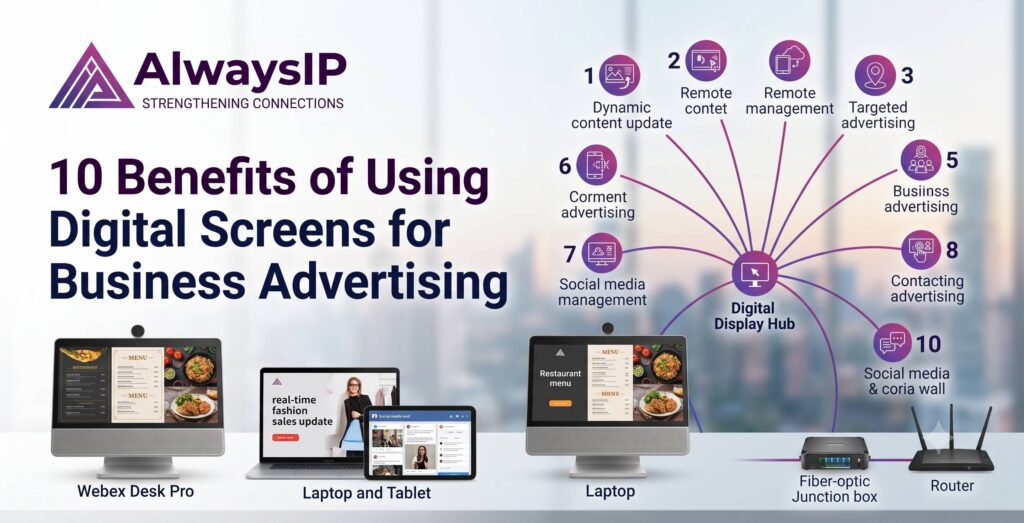
Digital Screens have become an effective advertising tool for businesses that want to capture attention, promote products and services, and communicate with customers more efficiently. Unlike traditional printed advertising, Digital Screens allow businesses to display dynamic content, update promotions quickly, maintain brand consistency, and adapt messages to different times and audiences. This blog explores 10 key benefits of using Digital Screens for business advertising and explains why they are becoming an important part of modern marketing strategies.
In a competitive business environment, attracting and keeping customer attention is becoming increasingly difficult. Traditional posters, banners, and printed advertisements can still be useful, but they often lack the flexibility needed to keep business messages fresh and relevant.
This is where Digital Screens can make a real difference.
From retail stores and offices to hotels, restaurants, reception areas, and public spaces, Digital Screens give businesses a flexible way to promote products, services, offers, and important information. They can display videos, images, animations, promotional messages, and interactive content, helping businesses create a more engaging advertising experience.
The main advantage of Digital Screens is not simply that they look modern. Their real value comes from the ability to change content quickly, schedule messages, maintain brand consistency, and deliver the right information at the right time.
Here are 10 important benefits of using Digital Screens for business advertising.
1. Digital Screens Capture Customer Attention
One of the biggest advantages of Digital Screens is their ability to attract attention.
People are naturally drawn to movement, changing visuals, video content, and bright displays. A static poster may be noticed once and then ignored, while a Digital Screen can continuously display different messages and visual content.
Businesses can use Digital Screens to show:
- Promotional videos
- Product demonstrations
- Special offers
- Animated advertisements
- New product launches
- Customer testimonials
- Brand messages
This makes advertising more visually engaging and gives businesses more opportunities to capture the attention of people walking past or waiting in a particular area.
For example, a retail business can display different promotions throughout the day, while a hotel can use Digital Screens to advertise facilities, events, and special offers to guests.
2. Content Can Be Updated Quickly
Traditional advertising materials often require businesses to design, print, deliver, and install new content whenever a promotion changes. This process can take time and create unnecessary costs.
Digital Screens make content updates much easier.
Businesses can change promotional messages, prices, product information, event details, and advertising campaigns without replacing physical materials. Depending on the Digital Screens solution, content can also be managed remotely.
This flexibility is especially useful for businesses that regularly run:
- Seasonal promotions
- Limited-time offers
- Flash sales
- Daily specials
- Event announcements
- Product launches
Instead of leaving outdated advertisements on display, businesses can keep their advertising current and relevant. The ability to update content quickly also helps businesses respond faster to changing customer needs and marketing opportunities.
3. Digital Screens Improve Customer Engagement
Advertising is more effective when it encourages people to notice, understand, and interact with a message.
Digital Screens can create a more engaging experience by combining text, images, videos, and animations. Interactive screens can also allow customers to explore products, services, directories, menus, and other useful information.
For example, a business could use a touchscreen to allow customers to browse:
- Product ranges
- Service options
- Pricing information
- Special promotions
- Business locations
- Frequently asked questions
Digital content can also include QR codes that direct customers to websites, online offers, contact forms, or product pages.
By creating a more interactive experience, businesses can make advertising feel less like a simple sales message and more like useful communication.
4. Better Brand Visibility and Recognition
Consistent branding plays an important role in helping customers remember a business.
Digital Screens allow companies to consistently display their:
- Logo
- Brand colours
- Marketing messages
- Taglines
- Products
- Services
- Promotional campaigns
When customers repeatedly see consistent and professionally designed content, it can help strengthen brand recognition.
Digital advertising also gives businesses more creative freedom. Instead of being limited to one static design, they can use multiple pieces of content in a single advertising space.
For example, one screen could rotate between a brand video, a customer testimonial, a product promotion, and a special offer.
This creates more opportunities to communicate the business’s brand identity and key messages.
5. Digital Screens Can Reduce Long-Term Printing Costs
The initial investment in Digital Screens may be higher than printing a single poster or banner. However, businesses that regularly update advertising materials may find that digital displays provide better long-term value.
Traditional advertising can involve repeated costs for:
- Graphic design
- Printing
- Shipping
- Installation
- Replacement
- Disposal of outdated materials
With Digital Screens, the same display hardware can be used for multiple advertising campaigns. Businesses can change the content without replacing the screen itself.
Over time, this can reduce reliance on short-term printed materials.
This is particularly useful for businesses with frequent promotions or multiple locations. A centrally managed digital advertising strategy can make it easier to update campaigns across different sites without printing and distributing new materials for every location.
6. Businesses Can Schedule Advertising at the Right Time
Not every advertisement needs to be displayed all day.
One of the most useful features of Digital Screens is content scheduling. Businesses can plan different messages for different times of the day.
For example, a restaurant could display:
- Breakfast promotions in the morning
- Lunch offers during the afternoon
- Dinner specials in the evening
A retail store could promote different products based on the time, day, or season.
An office could show visitor information during the day and employee communications at other times.
This helps businesses make their advertising more relevant to the people viewing it.
The right message at the right time can be more effective than displaying the same advertisement continuously.
7. Digital Screens Support Targeted Advertising
Businesses often communicate with different audiences throughout the day.
For example, a gym may have office workers visiting in the morning, students in the afternoon, and other members in the evening. A hotel may have different types of guests at different times of the year.
Digital Screens allow businesses to adapt content based on factors such as:
- Time of day
- Location
- Customer behaviour
- Seasonal campaigns
- Events
- Specific promotions
This creates more targeted advertising opportunities.
A business does not need to use the same message for every customer. Instead, it can display content that is more relevant to the audience likely to be present at a particular time or location.
More relevant advertising can improve engagement and make promotional messages more effective.
8. Digital Screens Can Influence Buying Decisions
Advertising is often most effective when customers are close to making a decision.
This is why the placement of Digital Screens is so important.
Businesses can install screens in strategic locations such as:
- Store entrances
- Reception areas
- Point-of-sale areas
- Waiting rooms
- Product displays
- Restaurant counters
- Hotel lobbies
- Exhibition spaces
A well-placed screen can promote a product, service, upgrade, or special offer at the moment when customers are most likely to take action.
For example, a restaurant can use Digital Screens to highlight premium menu items. A hotel can promote spa treatments or restaurant offers. A retail store can display related products near a particular section.
The key is to ensure that the advertising is relevant to the location and the customer journey.
9. Digital Screens Create a More Modern Business Environment
Customer perception matters.
The technology and visual presentation used by a business can influence how customers view the brand. Professional Digital Screens can help create a more modern and organised environment.
This can be particularly valuable for:
- Retail stores
- Corporate offices
- Hotels
- Restaurants
- Healthcare facilities
- Showrooms
- Educational organisations
A high-quality display can improve the overall appearance of a space while also serving a practical advertising purpose.
For example, instead of placing several posters around a reception area, a business can use one professionally managed screen to display rotating content.
This can make communication look more organised while helping the business present its brand in a modern and professional way.
10. Digital Screens Provide Greater Advertising Flexibility
Perhaps the biggest benefit of Digital Screens is flexibility.
Traditional advertising usually requires businesses to choose one message for one physical space. Digital advertising allows that same space to display multiple messages throughout the day.
Businesses can use the same Digital Screens for:
- Advertising
- Promotions
- Product information
- Videos
- Company news
- Event announcements
- Customer information
- Wayfinding
- Internal communication
This makes Digital Screens a versatile business communication tool rather than simply an advertising display.
A screen that promotes products in the morning can display customer information in the afternoon and company announcements later in the day.
For businesses looking to get more value from their physical space, this flexibility can be extremely useful. Digital signage can combine advertising, communication, and customer engagement within a single solution.
How to Get the Best Results from Digital Screens
Installing a screen alone is not enough to create effective advertising.
Businesses should also consider the following factors.
Choose the Right Screen Location
Screen placement can significantly affect visibility. Choose locations where the target audience is likely to notice the display.
Keep Content Simple
Avoid placing too much information on one screen. A clear message with strong visuals is often more effective than a crowded design.
Use High-Quality Visuals
Poor-quality images and videos can make even the best Digital Screens look unprofessional.
Update Content Regularly
Regularly changing content helps keep advertising fresh and prevents customers from becoming too familiar with the same message.
Include a Clear Call to Action
Tell customers what you want them to do next. This could include visiting a website, scanning a QR code, asking staff for more information, or taking advantage of a special offer.
Match Content to Your Audience
The most effective Digital Screens content is relevant to the people viewing it. Consider the location, time, and purpose of each message.
Why Digital Screens Are a Smart Investment for Business Advertising
Businesses are under constant pressure to communicate more effectively while managing advertising costs and maintaining a strong brand image.
Digital Screens provide a flexible solution to these challenges.
They allow businesses to replace static messages with dynamic content, update campaigns more quickly, reduce reliance on frequent printing, and create more engaging customer experiences.
However, the best results come from a clear strategy.
Before investing in Digital Screens, businesses should consider:
- Who will see the screen?
- Where will it be installed?
- What type of content will be displayed?
- How often will the content change?
- What action should viewers take?
- How will the advertising results be measured?
When these questions are considered carefully, Digital Screens can become an important part of a wider marketing and communication strategy.
Conclusion
Digital advertising is no longer limited to online platforms. Physical business spaces also provide valuable opportunities to communicate with customers, promote services, and strengthen brand awareness.
Digital Screens help businesses make better use of these spaces by delivering dynamic, flexible, and visually engaging advertising.
From capturing customer attention and improving engagement to supporting targeted campaigns and reducing long-term printing requirements, the benefits of Digital Screens are clear.
For businesses that want to modernise their advertising approach, keep promotional content up to date, and create a stronger visual presence, Digital Screens can provide a practical and effective solution.
The most important factor is not simply having a screen. It is having the right content, in the right location, delivered to the right audience at the right time.
With a well-planned strategy, Digital Screens can help businesses turn everyday spaces into powerful advertising opportunities.
Frequently Asked Questions About Digital Screens
1. What are Digital Screens used for in business advertising?
Digital Screens are used to display advertisements, promotional offers, product information, videos, company messages, menus, and other visual content. Businesses can use them in retail stores, offices, hotels, restaurants, reception areas, and other customer-facing locations.
2. Are Digital Screens better than traditional printed advertising?
Digital Screens offer greater flexibility because businesses can update content without replacing physical advertising materials. They can also display videos, animations, and multiple messages. However, the best option depends on the business’s advertising goals, location, and budget.
3. Can Digital Screens be updated remotely?
Many modern Digital Screens solutions allow businesses to manage and update content remotely through digital signage software or a central content management platform.
4. Are Digital Screens suitable for small businesses?
Yes. Digital Screens can be useful for small businesses that want to promote products, services, offers, or important information. The right solution depends on the business’s budget, location, and advertising requirements.
5. Where should businesses install Digital Screens?
Common locations include shop windows, store entrances, reception areas, waiting rooms, point-of-sale areas, hotel lobbies, restaurants, and exhibition spaces. The best location depends on where the target audience is most likely to see the content.
6. What type of content works best on Digital Screens?
Short, clear, and visually engaging content generally works best. Businesses can use videos, product images, promotional messages, animations, customer testimonials, and clear calls to action.