
In today’s fast-evolving business landscape, communication systems play a critical role in productivity, customer experience, and operational efficiency. With the UK moving towards digital transformation and the upcoming PSTN switch-off, businesses are increasingly evaluating their options between traditional landlines and modern VoIP systems.
This guide explores VoIP vs landline UK solutions in depth, helping you understand costs, features, and long-term value. Whether you’re a startup or an established enterprise, choosing the right phone system can directly impact your bottom line.
What Is a Traditional Landline Phone System?
A traditional landline system relies on the Public Switched Telephone Network (PSTN), using copper wires to transmit voice signals. These systems have been the backbone of business communication for decades.
Key Characteristics
- Fixed physical lines
- Limited scalability
- Basic calling features
- Requires on-site hardware
While landlines are reliable, they are quickly becoming outdated, especially with the UK’s shift away from PSTN infrastructure.
What Is a VoIP Phone System?
VoIP (Voice over Internet Protocol) allows businesses to make and receive calls over the internet rather than traditional phone lines. It is also commonly referred to as a cloud phone vs landline solution.
Key Features
- Internet-based communication
- Remote accessibility
- Advanced call management tools
- Easy scalability
VoIP systems are at the heart of modern communication, offering flexibility and cost efficiency for businesses of all sizes.
VoIP vs Traditional Phone System: Core Differences
Understanding the difference between a VoIP vs traditional phone system is essential before making a decision.
Technology
- Landline: Uses copper wires and PSTN
- VoIP: Uses internet connectivity
Flexibility
- Landline: Fixed location
- VoIP: Work from anywhere
Maintenance
- Landline: Requires physical maintenance
- VoIP: Managed via cloud
Scalability
- Landline: Expensive and complex
- VoIP: Instant and cost-effective
Landline vs VoIP Cost UK: Detailed Comparison
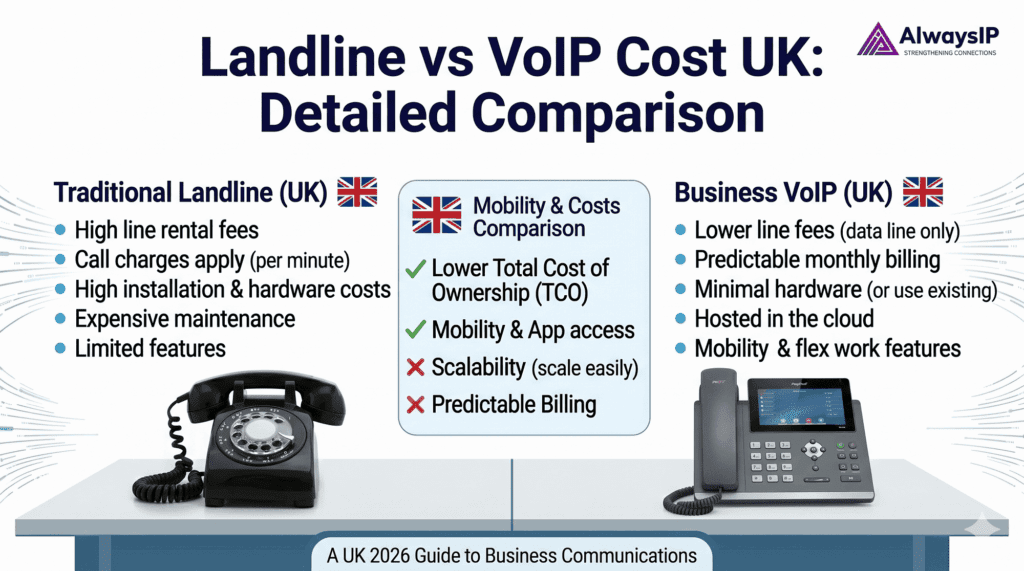
Cost is one of the biggest factors when comparing landline vs VoIP cost UK.
1. Setup Costs
Landline Systems:
- Installation fees for physical lines
- Hardware costs (desk phones, PBX systems)
- Engineer visits required
VoIP Systems:
- Minimal setup costs
- Often no installation fees
- Uses existing internet connection
👉 Verdict: VoIP is significantly cheaper to set up.
2. Monthly Costs
Landline:
- Line rental fees
- Higher call charges (especially international)
- Maintenance contracts
VoIP:
- Lower monthly subscription
- Free or low-cost internal calls
- Competitive international rates
👉 Verdict: VoIP offers better long-term savings.
3. Scalability Costs
Landline:
- Adding new lines is expensive
- Requires physical installation
VoIP:
- Add users instantly
- Pay only for what you use
👉 Verdict: VoIP is more scalable and budget-friendly.
VoIP Phone System Comparison: Features That Matter
When doing a VoIP phone systemcomparison, features are where VoIP truly stands out.
Basic Features (Both Systems)
- Call forwarding
- Voicemail
- Call waiting
Advanced VoIP Features
1. Auto Attendant
Automatically directs calls to the right department.
2. Call Analytics
Track call performance and customer interactions.
3. CRM Integration
Connect with tools like Salesforce or HubSpot.
4. Video Conferencing
All-in-one communication platform.
5. Mobile Apps
Make and receive calls from your smartphone.
👉 These advanced capabilities highlight key business VoIP benefits that traditional systems simply cannot match.
Business VoIP Benefits for UK Companies
Switching to VoIP offers several advantages that go beyond cost savings.
1. Remote Work Enablement
VoIP allows employees to work from anywhere, making it ideal for hybrid and remote teams.
2. Improved Customer Experience
Features like call routing and IVR ensure customers reach the right department quickly.
3. Future-Proof Technology
With the UK phasing out PSTN, VoIP ensures your business stays compliant and future-ready.
4. Easy Integration
Integrate with CRM, helpdesk, and collaboration tools for streamlined workflows.
5. Business Continuity
In case of outages, calls can be redirected instantly, ensuring zero downtime.
Cloud Phone vs Landline: Which Is Better for Your Business?
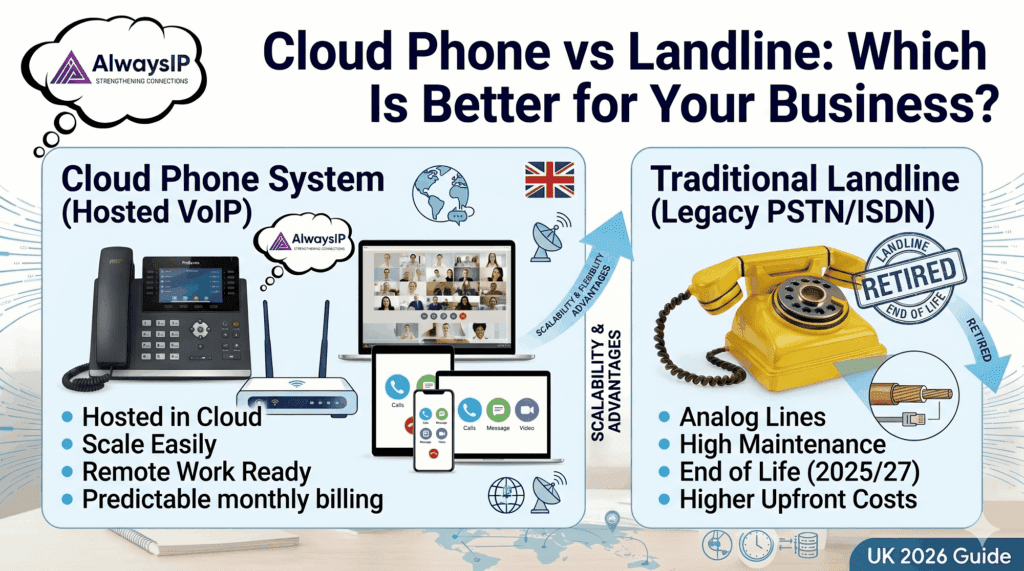
Choosing between a cloud phone vs landline depends on your business needs.
Choose Landline If:
- You operate in areas with poor internet connectivity
- You require a simple, fixed communication system
- You have minimal scalability needs
Choose VoIP If:
- You want to reduce communication costs
- You need flexibility and mobility
- You plan to scale your business
- You want advanced communication features
👉 For most modern UK businesses, VoIP is the clear winner.
Security Considerations
Security is often a concern when comparing VoIP vs landline UK systems.
Landline Security
- Physically secure
- Less vulnerable to cyber threats
VoIP Security
- Requires encryption and firewalls
- Can be highly secure with proper setup
👉 With the right provider, VoIP systems can be just as secure—if not more—than traditional systems.
The Impact of the UK PSTN Switch-Off
The UK government and telecom providers are phasing out PSTN networks by 2027. This means traditional landlines will no longer be supported.
What This Means
- Businesses must migrate to digital systems
- VoIP becomes the primary communication method
- Early adoption avoids last-minute disruption
👉 This makes the shift from landline vs VoIP cost UK not just a choice—but a necessity.
Final Verdict: VoIP vs Landline UK
When comparing VoIP vs landline UK, VoIP clearly stands out in terms of:
- Cost efficiency
- Flexibility
- Advanced features
- Future readiness
While landlines may still suit niche use cases, the majority of UK businesses will benefit from switching to VoIP.
FAQs
1. What is the main difference between VoIP and landline systems?
The main difference is that VoIP uses the internet for calls, while landlines rely on physical copper wires and PSTN networks.
2. Is VoIP cheaper than landline in the UK?
Yes, landline vs VoIP cost UK comparisons show that VoIP is generally more affordable, especially for long-term use and international calls.
3. Are VoIP systems reliable for businesses?
Yes, with a stable internet connection, VoIP systems are highly reliable and offer better uptime with failover options.
4. Can I keep my existing number when switching to VoIP?
Yes, most providers allow number porting, so you can retain your existing business number.
5. Is VoIP suitable for small businesses?
Absolutely. VoIP is ideal for small businesses due to its low cost, scalability, and advanced features.
6. What equipment is needed for VoIP?
You typically need:
- A stable internet connection
- VoIP-enabled phones or softphones
- A VoIP service provider
7. Will landlines stop working in the UK?
Yes, with the PSTN switch-off by 2027, traditional landlines will be phased out, making VoIP the future of communication.